
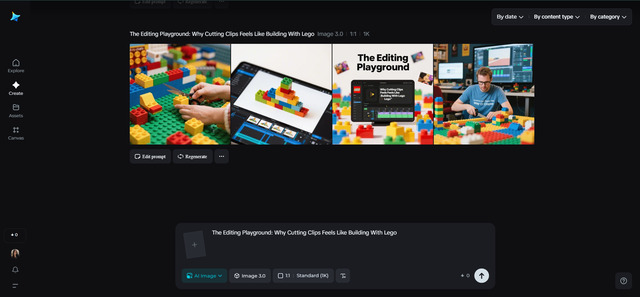
Visualize the Editing Playground: Why Cutting Clips Feels Like Building With Lego
Think of a video timeline as a box of bricks: jump in, sort pieces by color and size, and start stacking surprises. Editing is less about technical obedience and more about playful assembly — you try, break, recombine, and discover accidental delights. Wanna visualize the very scene? AI generators like Dreamina help with sandboxing: use an AI photo generator to create quick mood plates, title frames, or texture swatches you can throw into the timeline and see how they change the whole build. The best edits feel inevitable because someone kept fiddling until the pieces clicked.
Below, we'll explore why editors are really playful problem-solvers, how to set up a practice that invites experimentation, and tactical patterns (the LEGO moves) you can steal to make editing feel like joyful construction rather than endless trimming.
The basics: why play is the secret sauce of good editing
Serious craft often begins with play. When you treat footage like modular parts rather than sacred artifacts, you:
• Remove attachment to any single take,
• Encourage lateral thinking (what if the music came in earlier?),
• Open the door to serendipity (a flub becomes a gag), and
• Shorten your path to creative solutions.
Play creates low-stakes iterations. A ten-minute test edit teaches you more than a three-hour perfection attempt because you're sampling possibilities, not polishing illusions.
The Lego moves: repeatable editing maneuvers that spark magic
Editors develop a handful of rituals that feel like building techniques.
- The cornerstone: find one strong shot or sound and design everything around it. All other pieces support that moment.
- The hinge cut: a short J- or L-cut that flips viewer attention just when you want them to move — like placing a rotating hinge between two bricks.
- The quick stack: assemble several short clips into a rhythmic sequence; the energy of the rhythm disguises rough edges.
- The negative threshold: intentionally leave silence or black for a beat — it's the gap that makes the structure readable.
- The mismatch pivot: intentionally pairs image and sound that don't fully align; cognitive dissonance often creates interest.
These "moves" are combinable — mix and match until a satisfying structure emerges.
An iterative workflow that rewards curiosity
Create a workflow that privileges making over polishing.
• Rough pass: assemble clips in chronological order or find the strongest shots and lay them out.
• Remix pass: rearrange for surprise — try inverse order, group by color, or stack subject reactions.
• Tone pass: shape audio and color so the edit feels unified.
• Tighten pass: fix pacing, trim micro-beats, and nudge transitions.
Always keep versions; save the playful remixes. Often the best idea emerges after you've tried the "wrong" way.
Playful constraints that enhance creativity
Constraints are like pre-sorted Lego sets — they focus your invention. • Limit yourself to three shots per sequence, or • Try a silent edit where motion carries the narrative, or • Build with one camera angle only and invent motion with cuts. Constraints make you invent connective tissue: a cut, a sound cue, a motion match becomes the creative trick that holds the piece together.

The audio bricks: why sound is often the structural glue
Sound is the mortar between visual bricks. A rhythmic audio cue can make unrelated clips feel like one action. Use these audio-centric moves:
• Musical cuts on beats to create kinetic flow,
• Ambient matches (room tone) to smooth rough visual edits,
• Sonic stingers to punctuate comedy or reveal.
A great editor thinks in sound-first moves as often as visual ones.
Building empathy through timing
Timing is how you sculpt emotion. A half-second hold lets a face breathe; a long, slow dissolve invites nostalgia. Watch for micro-timing cues: inhale before a line, a blink, or a foot tapping. Those tiny beats are the studs you click to adjust a viewer's feeling.

Collaborative builds: working with a team like a playdate
When you collaborate, treat the edit like a group LEGO session. • Share small export "experiments" every day rather than one final cut, • Label your sequences with what you're testing (tone, tempo, or comedic beats), • Create a shared folder of "audio bricks" and "visual bricks" (stings, textures, title plates). Frequent, small feedback loops keep energy high and prevent creative logjams.
Quick visual identity: tiny marks that tie a series together
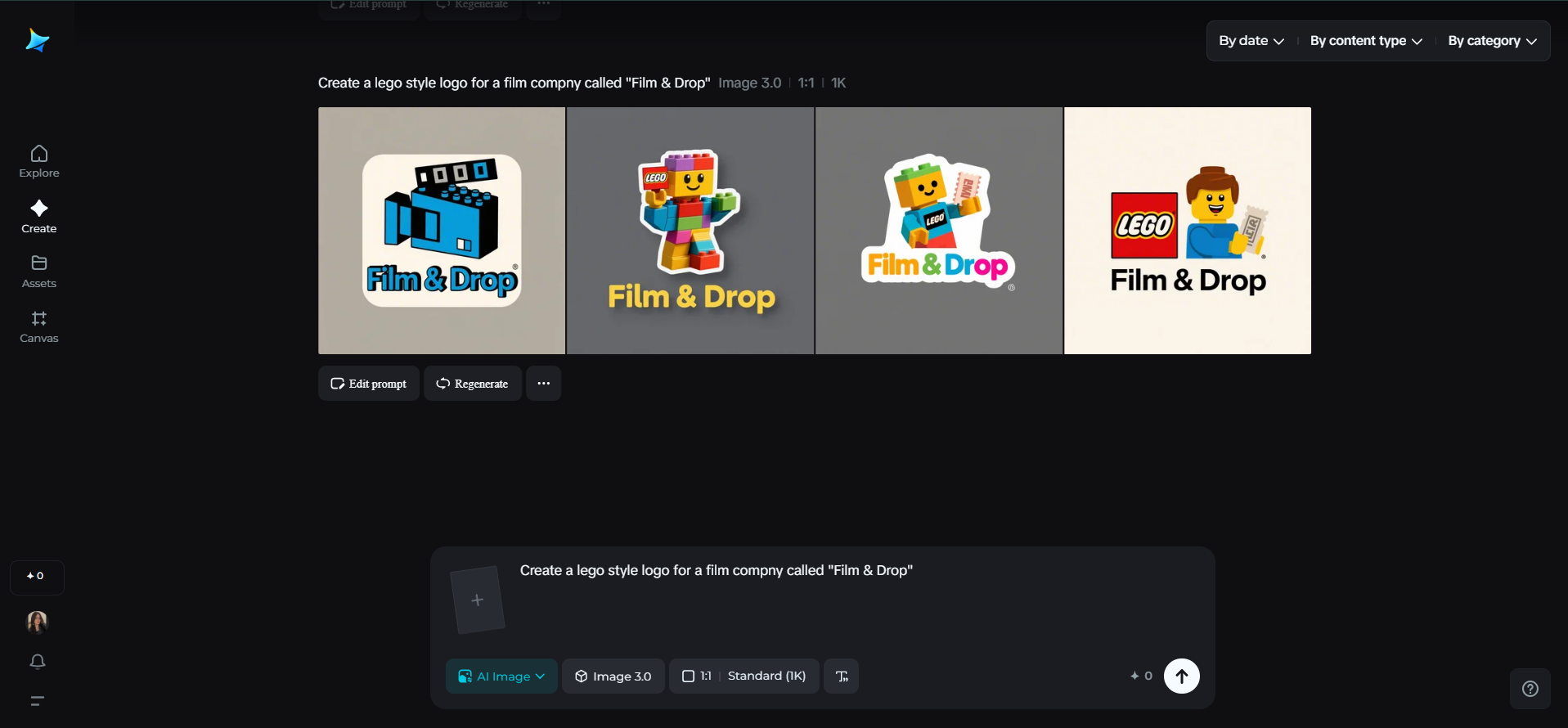
A recurring visual or transition is like a signature brick that makes every episode feel part of the same set. A short intro sting or a compact corner badge does the job. If you want logo ideas that read well at thumbnail sizes, Dreamina's AI logo generator can quickly produce small, legible marks you can test across a batch of edits.
The remix economy: reusing parts to multiply ideas
Once you've built a library of cuts, stings, and textures, reuse becomes a superpower. Recut previous footage into new formats — clips for social, a teaser reel, a silent loop — and you'll double (or triple) your output without new shoots. A free AI art generator can speed this up: roll up quick background textures or stylized plates for title cards, so your library grows richer without heavy design time.
Practice drills to make editing playful (ten-minute exercises)
Try these micro-drills to keep your skills nimble:
• The three-clip flip: pick three unrelated clips and make them tell a coherent mini-story.
• Silent montage: assemble a 15-second visual-only loop focused on texture.
• Reverse logic: edit the ending first, then build the beginning that makes the ending inevitable. These quick games rewire your brain for playful problem-solving.
Teaching yourself to let go
The hardest thing for many creators is to surrender the notion of "perfect first cut." Embrace a messy early version. Label it "play-1." Iterate from there. You'll discover more interesting solutions by looking sideways than by polishing straight ahead.
Ending the set: why Lego-thinking makes better editors
When you approach editing like play, the medium becomes more generous. You're less afraid to try absurd combos, to pivot tone with a single cut, or to find joy in a micro-beat that lands just right.
Dreamina helps by giving you quick visual anchors — mood frames, title assets, and texture plates — so your play has richer pieces. Start small: assemble a 30-second sequence from five clips and one sonic motif. Treat it like a prototype.
If it surprises you, build on it. If it doesn't, put it back in the box and try another arrangement. The edit is a playground; the more you play, the better you build.